S.O.U.L. – Can You Feel It ’72
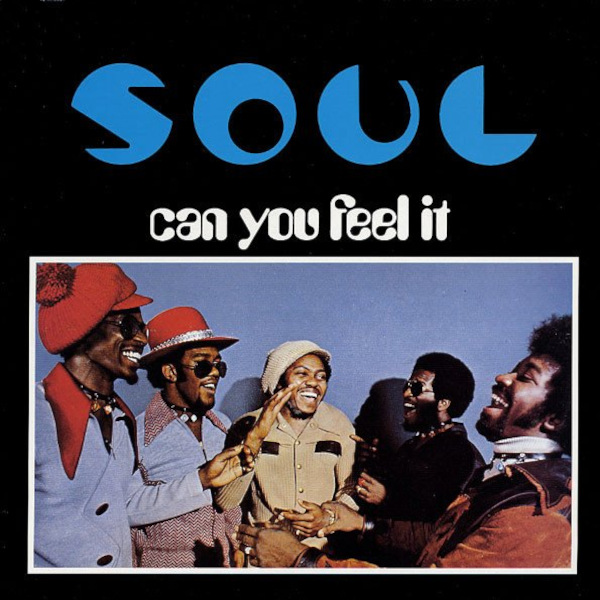
Zweites und letztes Studio-Album von S.O.U.L. (Sounds of Unity and Love), inkl. der Singles: „Tell It Like It Is“, „Can You Feel It“ und „To Mend A Broken Heart“.
Während das Debütalbum aus zahlreichen Coverversionen bestand, ist hier nur noch ein Cover von Stevie Wonders „My Cherie Amour” enthalten. (Siehe auch die Liner Notes unten.)
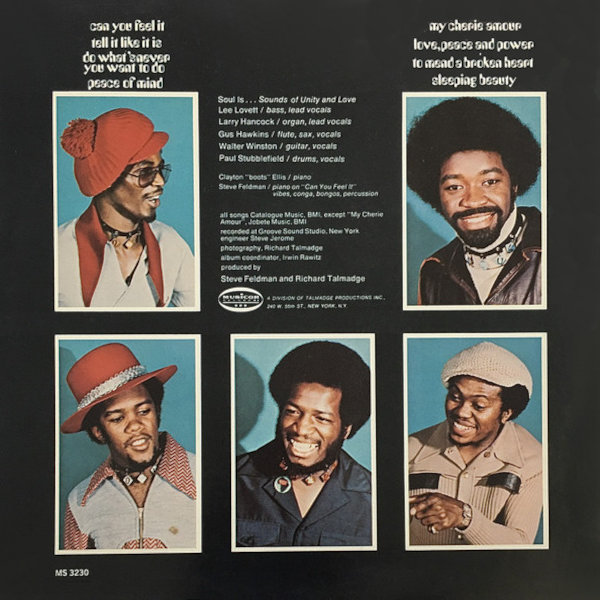
LP Liner Notes
S.O.U.L. – Sounds Of Unity and Love. I remember quite distinctly thinking to myself on hearing S.O.U.L.’s first LP „S.O.U.L. – WHAT IT IS“ how good this team sounded and how close they came to substantiating the claim made in the album title. Well, if like me you found the first LP a pleasant surprise, you’ll find this one a positive revelation. It’s superlative. Finally this hoary question, „What is soul?“ has finally been answered. Spread the news!
The group were actually discovered on the „Upbeat“ TV show which was running a talent contest, although in the event it was hardly a contest as S.O.U.L. won completely hands down. The group originally comprised Lee Lovett, who sings lead and plays bass and baritone and is a native of Detroit; Gus Hawkins who plays saxophone, flute and also sings, and he hails from Oakland Village, Ohio; Paul Stubblefield, second tenor and drums from Toledo, Ohio, and Walter Winston from Utaw, Alabama and he is the group’s guitarist. However for their second album they have added Larry Hancock, organ, Claton „Boots“ Ellis on piano and Steve Feldman on percussion and piano (on „Can You Feel It“ only).
The team have continued to use the same format on this LP – one of occasional vocals over snazzy, jazzy instrumentals – but have moulded their own thing, carved their individual niche one step still further from many of the tired and stale cliché riddled sounds that comprise the mainstream of music today. This refreshing approach can be heard right from the very opening of the LP. With a smash of the cymbal that will make the unwary jump right out of their skin, the band groove into „Can You Feel It“ which has an almost jam session informality as tenor sax man Gus Hawkins lays down his boppish, hard blues line. Enter Lee Lovett who asks „Can You Feel It?“ not just once but over and over, as the rest of the group, unable to contain themselves in the face of the smouldering atmosphere being created all around them, burst joyously forth with „yes I feel it!“ A superb opener to their live shows I would have thought and no doubt would have the gallery on it’s feet in seconds. „Tell It Like It Is“ has the united voices of the group cooking away over a hot and driving wah-wah rhythm. The chord changes are great and the whole song flows like Saxe salt!
I would have thought that socially orientated songs and dance songs would make strange bedfellows but on „Do What So Ever“ they are cunningly brought together in a totally unexpected new twist. The world is told, „no matter what your color, red, yellow, white or what, don’t worry about tomorrow we’re gonna get down tonight!“ Why didn’t anyone think of that before!
If the world did take time out to listen, it would hear ethereal, almost ghostly chants from the group and insistent, gritty instrumental statements from the sax, and also from guitar man Walter Winston. Arms would be laid down, tensions lifted while every man, woman and child freaked out to these roaring boogaloo rhythms. („Music is a science that would have us laugh and sing and dance“ – Guillaume Machaut c. 1300-1377).
„Peace Of Mind“ is also rhythmically exciting with relentless, dirty licks abounding. Yea this is a BAD one all right! Incidentally words should not be taken too lightly.
„My Cherie Amour“, the pop-soul evergreen opens side two. It’s respectfully treated to a most tasteful facelift by the band. Highspots include pleading vocal work from Lee, whose soulful almost frantic performance has to be heard to be believed, and also the short, staccato bursts from the brass.
„To Mend A Broken Heart“ is a more traditional soul ballad, and an extremely fine one at that. One hears echoes of acappella, street corner harmonies filtering through the thick funkadelic packaging, and while it is neither a doo-whop record, nor some wild wah-wah Afro-acid workout, it is a splendid eclectic number that is very cool and very different. Catch the sad sack, sad sax horn break – how loss and lonesome it sounds!
Two tracks bring the genius of Gus Hawkins once more to the fore, but on „Love, Peace And Power“ and „Sleeping Beauty“ he is to be heard, most excellently, on flute this time. (Any jazz virtuoso will tell you how hard it is to play well on both reed and wind instruments). The former track is a racey, pacey, slab of mello-funk that brings to mind good background music to some dick-flick while the latter is an exquisite after-hours ballad. Just close your eyes for a second and it’s not hard to imagine you’re in some swish nightclub complete with dimmed lights and expensive drinks! It’s a relief to find that Gus does not fall into the old trap of grunting, groaning and mumbling through his instrument – something that was a gas when Roland Kirk first did it, but it’s a bore coming from imitators. Gus Hawkins is definitely NOT. He really does excell on this final track evoking all kinds of melancholic responses. Suddenly without warning the track fades leaving you unexpectedly in the kind of happy-sad nostalgic mood that takes a good few minutes for you to shake off. Then you find yourself clearing the lump in your throat in the ensuing silence and lift the record slowly off the turntable.
As I said before, this album is a revelation, it seems S.O.U.L. are getting better with the time – the prospect of the next LP scares me to death!
by Jon Philibert
Cream magazine
London, England.


S.O.U.L. (Sounds of Unity and Love) Websites
Gegründet 1970 in Cleveland, Ohio, USA